Monday, 6 January 2014

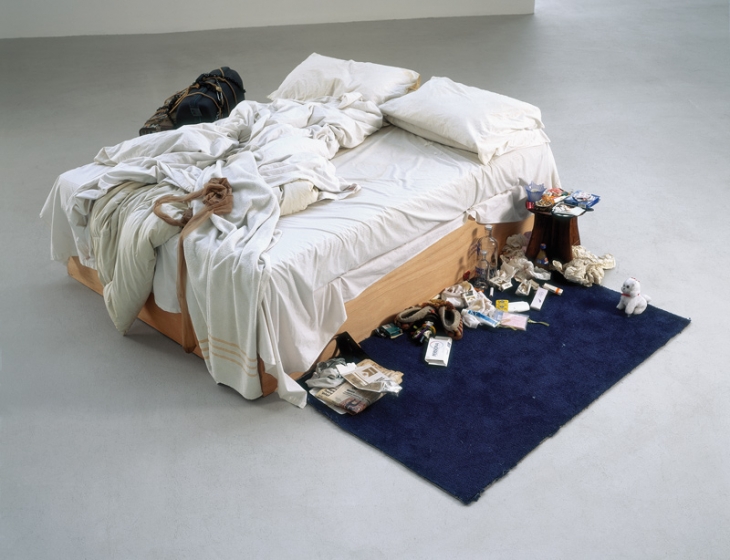
Tracey Emin: My Bed

Tracey Emin, My Bed, 1998, Mattress, linens, pillows, objects, 79 x 211 x 234 cm

Tracy Emin created, 'My Bed,' in 1998 and it was exhibited in the Tate in 1998 as one of the shortlisted works for the Turner Prize. It is a view of her bed when she was in a state of suicidal depression. The objects and mess she has around her bed gives the audience a clear insight into her life. Emin's work inspired my print project as it featured the accumulation of rubbish which is then dispersed in the artwork.

My Rubbish Life, Mixed Media Collage on A1 paper, 841 x 594mm.


Sunday, 5 January 2014

My Rubbish Life


My Rubbish Life, Mixed Media Collage on A1 paper, 841 x 594mm.

Summer Work: David Shrigley

David Shrigley was born in 1968 and is a contemporary British artist who lives and works in Glasgow. He studied a Foundation in Art and Design at Leicester Polytechnic (De Montfort university) and later when onwards to study Enviromental Art at Glasgow School of Art. Shrigleys art strives to be humorous. Which it often is, but humor like art is all about an individuals taste. He was shortlisted for the Turner Prize for his exhibition, 'Brain Activity' at the Hayward Gallery.


Talking About Drawing Robert Longo

Robert Longo born in 1953 is an American contemporary artist. I saw his piece, Untitled (In the garden, et in Arcadia ego) at Frieze and it took up most of the wall at 152.4 x 304.8 cm. It is a drawing of a Forrest scene in charcoal on mounted paper.


I translated the title from Latin and discovered it meant, 'In the garden and I am in Arcadia/Paradise.' I researched Arcadia and it is a place in Greece however in poetic fantasy it represents a pastoral paradise and in Greek mythology it is the home of Pan, the Greek god of nature.

I chose to talk about this piece as technically it is really amazing. When I first saw it at Frieze I thought that it was a black and white photograph but as I got closer I realised  it was a drawing. Secondly I like the contrast of the light shining through the darkness of the Forrest.

When I first looked at this drawing I thought Longo could have been inspired by this incredible view he saw. Inspiration formed from the shadows in the Forrest into his mind and he felt he just had to convey the beauty of nature. However after a second look at his piece I found it very commercial, I struggled to find a meaning behind the work and as it is technically a very good piece of artwork a vast number of people may appreciate it and perhaps buy it. However after discussing this piece in the drawing session it is more likely that this piece is actually about death. The phrase, 'et in Arcadia ego,'  is often used in artwork to show death, as the person has gone to paradise or Heaven. The strong contrast of light and dark also suggests death as light is often associated with Heaven and the light seems to be drawing you in towards it, like the expression, "go towards the light".

The process' of Longo's drawings involves him projecting a photograph onto a piece of paper and then tracing the figures in graphite. He then has his illustrator, Diane Shea, fill in details. Then he goes over the work in graphite and charcoal.

Group Presentation: Greta Alfaro

Greta Alfaro born in 1977, is a Spanish contemporary artist that lives and works in London. In her work she mainly focus's on photography and video although she does produce collages from found publications.

COLLAGES, 2008-2011
Collage with found publications
32 x 42 cm


 We decided to look at her work, 'Fall on us, and hide us.' This features a large derelict room. In the foreground there are scattered bones then in the middle ground there is a carcass elevated by a sort of brightly coloured altar. Judging by her photography of from, 'Fall on us, and hide us,' this carcass is that of a goat.

FALL ON US, AND HIDE US, 2011
Colour photograph
145 x 112 cm.

FALL ON US, AND HIDE US #2, 2011
Colour photograph
145 x 112 cm.

FALL ON US, AND HIDE US #3, 2011
Colour photograph
70 x 75 cm

The video piece features the projection of light across the entire scene to the rhythm of the music playing. The viewer becomes transfixed on it blinded by the light and taken in by the music. I think the reason why the piece is called, 'Fall on us,and hide us,' because of how the light falls on the scene  revealing this mass grave of animal bones but when the light is gone it is hidden.  

FALL ON US, AND HIDE US, 2011 (excerpt)
Video installation/vertical projection
HD, colour, sound, 16:9, 8min.
Music by Melissa Bugarella

Alfaro's work is often about the unseen as she states, “I work about the hidden and the unexpected. We live our lives governed by rules created in order to control chaos and vulnerability, but I am interested in the facts we try to hide or repress, in the differences between the private and the public, in the visibility of our everyday life hypocrisy.”
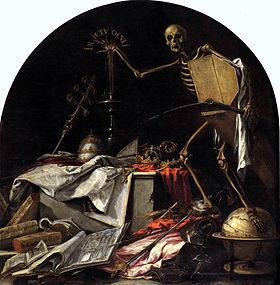
In Ictu Oculi

In the Saatchi Gallery there was a small dark side room with benches where a video was playing. There was no information provided. The video had already started; there was a table set up for a dinner party in the wilderness. An elaborate spread with silverware laden with food plus bottles and glasses of wine.  The table cloth blows gently in the wind creating a sort of ghostly presence. I sat and wondered for a while if this was all that was featured in the piece. Then I heard small squawking sounds that gradually grow louder. Shadows appeared and in a blink of an eye the dinner party guests swoop down and start gorging themselves.  I became transfixed watching this happen. Within minutes everything is devoured and then they just leave again. I waited for the video to start again and briefly a name in the corner flashes, Greta Alfaro.


The piece itself is called, 'In Ictu Oculi,' which roughly translated as, 'in the blink of an eye,' which is the manner in which the vultures appear. This piece by Greta Alfaro shares it's name with a baroque painting by Juan Valdes Leal.


Juan Valdes Leal, In Ictu Oculi, 1672.


This hints that Alfaro was influenced by Valdes Leal and they both do seem to feature similar themes, of chaos and death. They both also feature movement, Alfaro's by the nature of the media (video) and Valdes Leal by the pose of the skeleton; leaning as though in the middle of action.

I chose to talk about Alfaro's, In Ictu Oculi as although I don't really understand the meaning of it, the first time I watched it I was just fascinated by it and it was the most memorable piece of art that I saw in London.


Friday, 3 January 2014

Summer Work: Rachel Whiteread

For What It's Worth: Perceptions of Value in Contemporary Art.

I saw a piece by Rachel Whiteread at an exhibition put on by MA Curation Students at Norwich University College of the Arts. The exhibition questions what is art and how is it valued.

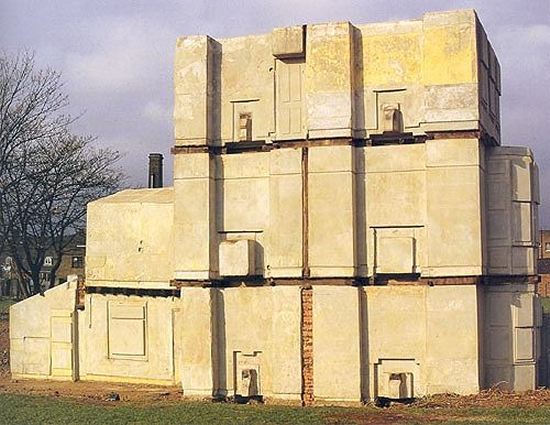
Rachel Whiteread is a leading British contemporary sculptor. She won the Turner Prize in 1993 for her work titled 'House'; a concrete cast of a Victorian house. In a review The Independant said, "A strange and fantastical object which also amounts to one of the most extraordinary and imaginative sculptures created by an English artist this century".  However 'House' generated mixed responses as she also won the K Foundation art award in 1994 for worst British artist. She is one of the Young British artists, a group that also includes Damien Hirst and Tracey Emin.


House 1993
House, 1993, Rachel Whiteread, concrete cast of Victorian House.

The piece exhibited in the For What It's Worth exhibition by Whiteread is Untitled 1993 and is exhibited under the subsection: The Materiality of small things. The piece is a doorknob cast in bronze. I think that this piece the artist tries to get us to question the meaning behind the artwork as an ordinary object has been elevated to a higher status by being put in a different context; displayed in a glass box on top of a white pedestal.

The artwork makes me wonder if this object has a significant meaning to the artist and then I wonder about the everyday objects that have special meaning to me: ones affiliated with memories, good and bad.

This piece of work reminds me of  Marcel Duchamp's 'Fountain'. He elevates an everyday object, a urinal, to a piece of artwork by a signature and an exhibition. Increasing the objects value significantly in monetary terms.